
Int J Curr Pharm Res, Vol 17, Issue 3, 37-40Original Article
PERSPECTIVE COMPARISON OF VARIOUS TEACHING METHODOLOGIES EMPLOYED IN TEACHING OF FIRST YEAR MBBS STUDENTS
KUMAR VIVEK ANAND1, MIMOH SHARMA2, VIBHAV NIGAM3, PREM PRAKASH BHARTI4, ANAND BIHARI5*
1Department of Biochemistry, Maharshi Vashishtha Autonomous State Medical College, Basti, UP, India. 2Department of Biochemistry, Integral Institute of Medical Sciences and Research, Uttar Pradesh, India. 3Department of Biochemistry, King George Medical University, Lucknow, Uttar Pradesh, India. 4Department of Community Medicine, Maharshi Deoraha Baba Autonomous State Medical College, Deoria, Uttar Pradesh, India. 5Department of Community Medicine, Maharshi Vashishtha Autonomous State Medical College, Basti, Uttar Pradesh, India
*Corresponding author: Anand Bihari; *Email: anandbhu05@gmail.com
Received: 20 Jan 2025, Revised and Accepted: 10 Mar 2025
ABSTRACT
Objective: To assess the perception of first-year MBBS students about different teaching methodologies and providing valuable suggestion in formulation of effective medical education curriculum. Understanding of basic subject like Biochemistry plays a significant role in development of future clinician. The student not only provides deep knowledge of different metabolic process inside our body but also establishes the diagnosis of various diseases. Therefore, developing effective and integrated subject-matter learning will enable an emerging student to build a strong foundation. Additionally, regular evaluations of effective teaching methodologies will help further.
Methods: The data was analyzed from the feedback form of a questionnaire from the first-year student at the end of six month of their curriculum year. The self-administered questionnaires were related to different teaching methodologies, its effectiveness in development of knowledge, exam preparedness.
Results: Regarding the combination approach of all the teaching methods like Lecture Session (LS), Clinical Case Session (CCS), Self Group Discussion (SGD) and Experimental Skill Session (ESS), most students (94.0%) felt that understanding the biochemistry subject becomes better. Additionally, 93.5 % believe that combined methodologies highlight biochemistry's applicability in clinical medicine.
Conclusion: Throughout the study, combination of teaching methodologies is better perceived by majority of the students in understanding of the biochemistry subject. As per the study, blending of teaching methodologies are better than a single method because inherent cons of one is compensated by the other.
Keywords: First-year MBBS, Medical education, Students’ perspectives, Teaching methodology
© 2025 The Authors. Published by Innovare Academic Sciences Pvt Ltd. This is an open access article under the CC BY license (https://creativecommons.org/licenses/by/4.0/)
DOI: https://dx.doi.org/10.22159/ijcpr.2025v17i3.55050 Journal homepage: https://innovareacademics.in/journals/index.php/ijcpr
INTRODUCTION
Biochemistry is one of the pillars which have to be erected during the foundation year of Indian graduates for future clinicians. Biochemistry being the language of human biology not only elaborates the basic understanding but also upholds the fundamental facts in medical students. Clinical Biochemistry, one of the key subjects in clinical medicine basically deals with various laboratory analysis of body fluids. It has been accepted that for better clinical decision-making, one must have profound knowledge of basic medical sciences [1]. Hence, there is utmost need of building sound foundation in young students so that they may able to make proper diagnosis and effective management. And, in order to achieve this, educational institutions must perform research and assessment of teaching methodologies periodically [2].
Current medical Education must formulate an effective teaching curriculum leading to successful delivery of critical knowledge of the basic medical sciences.
MATERIALS AND METHODS
This study was carried out in department of Biochemistry, MVASMC, Basti, Uttar Pradesh, India. A total 100 students of first MBBS course were included in the study. Informed oral consent was taken from the enrolled participants and approval of institutional ethical committee also obtained.
Combination of teaching methods
In the teaching methodologies, lecture sessions were usually held on a particular topic, after which self-group discussion (SGD) was conducted on the same topic for better understanding and deep learning of the topic. SGD provides the platform to pupils where they interact with each other and discuss their understanding under guidance of faculties. Additionally, the same topic was followed by Experimental skill sessions (ESS), where students perform the qualitative or quantitative estimation of various analytes in human body. This was followed by Clinical Case Session (CCS) of the same topic where the session forces them to reason their biochemical understanding and establishes the diagnosis of given case, after which clarifications and explanations were provided by attending faculties.
At the end of the semester, their understanding was evaluated in the form of multiple-choice and subjective questions. Additionally, assessment of the effectiveness of our teaching methodologies was planned by a formative assessment with a feedback form, after which students' perceptions were gathered regarding the effectiveness and usefulness of multiple teaching tools through a self-administered questionnaire.
Statistical evaluation
The information was gathered in Microsoft Excel, displayed in tables and pie charts, and analyzed subsequently.
RESULTS
The majority (90%) of the students felt that lecture sessions delivered basic subjective information very efficiently and also accepted that self-study became easier (82%). However, most of the enrolled students (96.5%) emphasized that CCS helped them correlate theory concepts with their clinical applicability and was able to generate their interest in biochemistry subjects (93.0 %).
Table 1: Student's perception towards different teaching methodologies in
| Students perception towards different teaching methods | Responses | ||
| Agree | Partial | Disagree | |
| (A) Questionnaire for Lecture Sessions | |||
| 1. Lecture delivers basic subject information efficiently | 90 | 10 | 0 |
| 2. Lecture sessions simplify the complex concepts and pathways, after which self-study becomes easier | 82 | 17.5 | 0.5 |
| 3. Revision of attended lecture via textbook and lecture notes helps in memorization | 85.5 | 14 | 0.5 |
| B) Questionnaire for Clinical case Sessions (CCS) | |||
| 1. CCS helped me to correlate theory concepts with their clinical applicability | 96.5 | 3 | 0.5 |
| 2. CCS provokes critical thinking required regarding laboratory investigations, their interpretation and decision-making skills | 89 | 10 | 1 |
| 3. CCS generates my interest in biochemistry as well as its importance in clinical medicine | 93 | 6 | 1 |
| (C) Questionnaire for Self-Group Discussion | |||
| 1. SGD causes the development of my oration skill efficiently | 67.5 | 31 | 1.5 |
| 2. SGD participation causes clarification of doubts with faculty member and batchmates | 84.5 | 15 | 0.5 |
| 3. SGD provides better and effective way to plan our study and different ways to re-call them during exam sessions | 74.25 | 25 | 0.75 |
| (D) Questionnaire for Experimental Skill Sessions | |||
| 1. ESS bolster confidence for learned concepts during lecture sessions | 75 | 22.5 | 2.5 |
| 2. ESS builds my critical ability to reason and understand different concepts and pathways | 91.5 | 7.5 | 1 |
| 3. ESS establishes the importance of Biochemistry in day-to-day clinical practice | 91 | 7.5 | 1.5 |
| (E) Combination of all of the above methods | |||
| 1. Combination of above methods employed in teaching helped me to understand biochemistry subject in a better way | 94 | 5.5 | 0.5 |
| 2. Above methodologies builds confidence and prepares me to face examination very efficiently | 76 | 23.5 | 0.5 |
| 3. Combination of all methods highlights the role of applicability of Biochemistry in clinical practice | 93.5 | 6 | 0.5 |
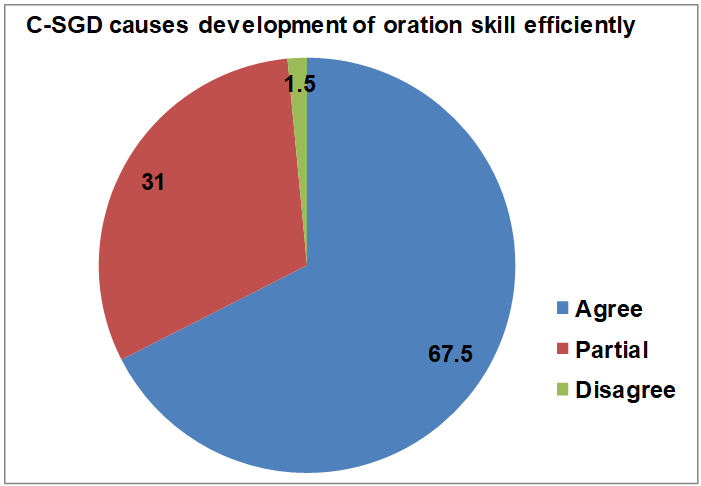
Fig. 1: Students perception in percentage towards SGD methods
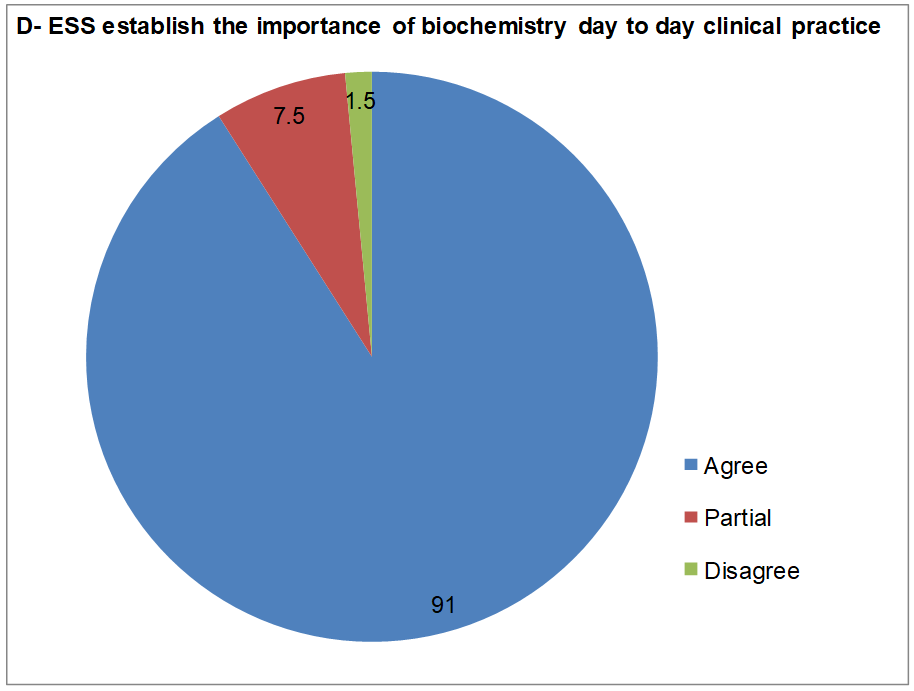
Fig. 2: Students perception in percentage towards ESS method
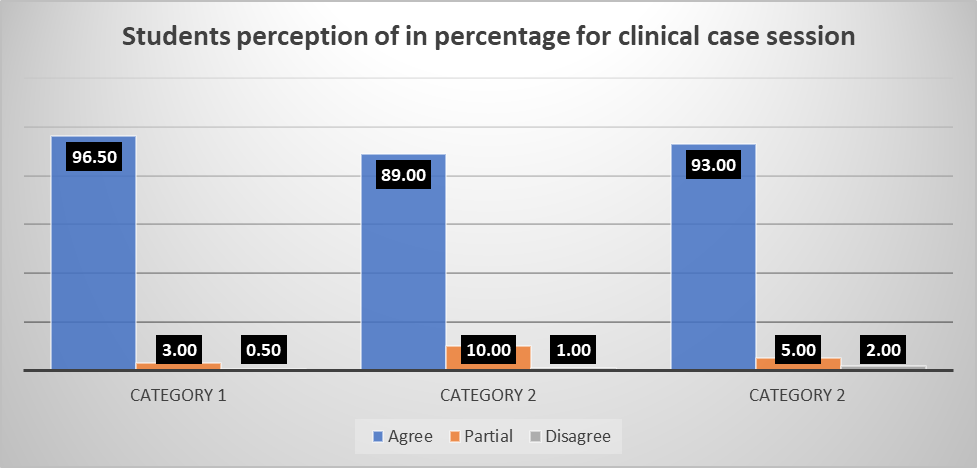
Fig. 3: Student's perception of in percentage for clinical case session, category 1-CCS helped me to correlate theory concepts with their clinical applicability, Category 2-CCS provokes critical thinking required regarding laboratory investigations, their interpretation and decision-making skills, Category 3-CCS generates my interest in biochemistry as well as its importance in clinical medicine.
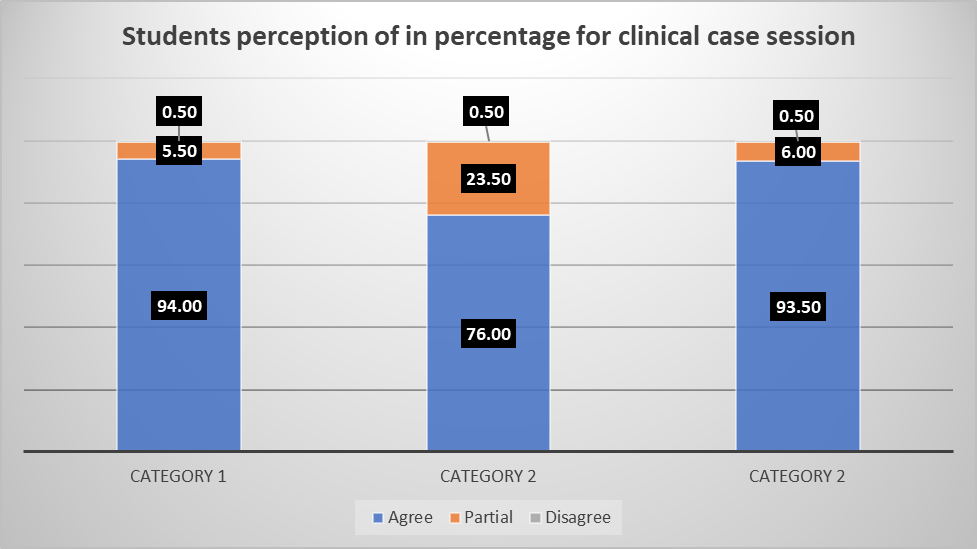
Fig. 4: Students perception of in percentage for clinical case session, category 1-CCS helped me to correlate theory concepts with their clinical applicability, Category 2-CCS provokes critical thinking required regarding laboratory investigations, their interpretation and decision-making skills, Category 3-CCS generates my interest in biochemistry as well as its importance in clinical medicine
According to the students' responses to the SGD survey, 84.0% of them think that it is helpful in resolving various doubts. However, nearly one-third of them (31%) don’t think that oration abilities developed efficiently [fig. 1].
In ESS session, 91.5 % students opined the view that attending the session, understanding gets better. Also, a majority of the students (91.0 %) think that their involvement in ESS highlights the importance of biochemistry in day-to-day clinical practice [fig. 2].
Regarding the combination approach of all the teaching methods like LS, CCS, SGD, and ESS, most students (94.0%) think that understanding biochemistry became better. Also, 93.5 % opined that combined methods highlight biochemistry applicability in clinical medicine efficiently.
DISCUSSION
It was observed that the time spent in teaching fundamental courses has been significantly reduced from 18 mo to 12 mo [3]. A curriculum framework for competency-based undergraduate medical education has also just been introduced by NMC [4]. In the majority of medical institutions, lectures are followed by experimental sessions, clinical discussions, and self-group discussions to teach fundamental concepts like biochemistry. Basic subjects are taught in the first years of medical school to assist students in developing their critical thinking, problem-solving, and decision-making abilities [5]. After the first year, students in medical school typically encounter a diagnostic conundrum and solve it using what they learned in earlier years.
However, a lot of evidence suggests that students are not getting exposure to clinical skills in their initial year to become successful doctors [6]. Interestingly, their position may be better in remembering/reconstructing multiple links between clinical features and diagnosis if the fundamental subject has been presented in detail and over time [7]. Additionally, studies have shown that LS, followed by SGD, helps student learn better since it stimulates group work and results in strong subjective memory [8]. A similar argument was made by Momeni Danaei et al., who claimed that using a variety of teaching techniques in conjunction rather than just one improves student learning [9]. Therefore, contextual learning is crucial for producing competent doctors, and its efficiency must be periodically evaluated using a variety of assessment methods.
The goal of the current study was to determine how well different teaching approaches for biochemistry subjects worked. According to the study, most students believe that a combination of teaching approaches such as LS, CCS, SGD, and ES Shelp the students in understanding of the subject better than single teaching methods, which has their own inherent merits and demerits. Learning can be defined as a change in one’s long-term memory [10]. The majority of the students in this survey expressed the opinion that LS does a better job of delivering fundamental knowledge and revising the material but that they only gain confidence by following ESS. Interestingly, taking part in SGD helps students not only get their questions answered but also strengthens their oratory talents to some extent. Also, by participating in CCS, students are able to link theoretical ideas to their practical relevance with development of interest in biochemistry. After actively participating in CCS, students strongly advocated for the development of critical thinking skills in investigations, interpretation, and decision-making, underlining the clinical relevance of the biochemistry subject.
Additionally, students lose confidence when they can't recall the principles they've learnt from a single or mixed teaching methodology on an exam. Therefore, the aforementioned issues necessitate attention in order to assist students in overcoming their exam phobia.
CONCLUSION
According to the study, the majority of students consider a combination of teaching approaches to have a positive impact on their comprehension of the biochemistry subject. Furthermore, combining instructional approaches is preferable to using only one because the inherent drawbacks of one are offset by the benefits of the other. Hence, the most effective teaching is when all the different teaching approaches are used together.
The research also indicates that there is room for improvement in teaching strategies, and by carrying out the required intervention; we may improve even more in the eyes of the students.
ACKNOWLEDGMENT
Nil
FUNDING
Nil
AUTHORS CONTRIBUTIONS
All authors have contributed equally
CONFLICT OF INTERESTS
Declared none
REFERENCE
Brass EP. Basic biomedical sciences and the future of medical education: implications for internal medicine. J Gen Intern Med. 2009;24(11):1251-4. doi: 10.1007/s11606-009-0998-5, PMID 19882372.
Khodaparast Haghi A. New perspectives in engineering education: the promotion of traditional models to innovative solutions. J Eng Educ. 2005;7(28):11-22.
Lata H, Walia L. Appraisal and improvisation of undergraduate practical curriculum in physiology. SE Asian Jnl Med Educ. 2010;4(1):55-8. doi: 10.4038/seajme.v4i1.439.
National Medical Commission. Available from: https://www.NMC.(n.d.).nmc.org.in/information-desk/forcolleges/ug-curriculum. [Last accessed on 06 Oct 2022].
Finnerty EP, Chauvin S, Bonaminio G, Andrews M, Carroll RG, Pangaro LN. Flexner revisited: the role and value of the basic sciences in medical education. Acad Med. 2010;85(2):349-55. doi: 10.1097/ACM.0b013e3181c88b09, PMID 20107367.
Engel FE, Hendricson WD. A case-based learning model in orthodontics. J Dent Educ. 1994;58(10):762-7. doi: 10.1002/j.0022-0337.1994.58.10, PMID 7962913.
Elizondo Omana RE, Morales Gomez JA, Morquecho Espinoza O, Hinojosa Amaya JM, Villarreal Silva EE, Garcia Rodriguez MD. Teaching skills to promote clinical reasoning in early basic science courses. Anat Sci Educ. 2010;3(5):267-71. doi: 10.1002/ase.178, PMID 20809498.
Joshi KB, Nilawar AN, Thorat AP. Effect of case-based learning in understanding clinical biochemistry. Int J Biomed Adv Res. 2014;5(10):516. doi: 10.7439/ijbar.v5i10.920.
Momeni Danaei SH, Zarshenas L, Oshagh M, Omid Khoda M. Which method of teaching would be better; cooperative or lecture. Iran J Med Educ. 2010;11(1):24-31.
Kirschner PA, Sweller J, Clark RE. Why minimal guidance during instruction does not work: an analysis of the failure of constructivist discovery problem-based experiential and inquiry-based teaching. Educ Psychol. 2006;41(2):75-86. doi: 10.1207/s15326985ep4102_1.