
Int J Curr Pharm Res, Vol 17, Issue 6, 69-71Original Article
PERCEPTION AND ATTITUDE OF POSTGRADUATE STUDENTS TOWARDS DISTRICT RESIDENCY PROGRAMME
PADMA SRAVANI SAGI1*, A. VENKATA KALYAN KUMAR2, B. R. SHYAM PRASAD3
1Pharmacology, Gmc, Anantapuramu, Andhra Pradesh, India. 2Radiology, Gmc, Anantapuramu, Andhra Pradesh, India. 3Biochemistry, Gmc, Anantapuramu, Andhra Pradesh, India
*Corresponding author: Padma Sravani Sagi; *Email: padmasravani19@gmail.com
Received: 15 Aug 2025, Revised and Accepted: 08 Oct 2025
ABSTRACT
Objective: The District Residency Programme (DRP) for postgraduate medical students has been made mandatory by the national medical commission of India (NMC). As part of the course curriculum, it includes a compulsory three-month rotation in District Hospitals or within the District Health System. The objective of this study is to assess the perception and attitude of postgraduate students towards the DRP at Government Medical College, Anantapuramu, Andhra Pradesh, South India.
Methods: A total of 158 postgraduate students who had attended DRP postings were included in the study. Among them, 98 were second-year students and 60 were third-year students. Data regarding their perceptions and attitudes toward the DRP postings were collected through a structured questionnaire using Google Forms.
Results: Data analysis was carried out using Microsoft Excel. Among the second-year and third-year postgraduates, 55% and 56% were male, while 45% and 44% were female, respectively. The overall perception and attitude of the students revealed that the majority held a neutral opinion regarding the DRP postings.
Conclusion: The district residency programme in the postgraduate curriculum does not appear to offer significant perceived benefits to the students. Furthermore, accommodation and food facilities provided during the postings were reported to be inadequate.
Keywords: District residency programme (DRP), Perception, Attitude, Postgraduate students, National Medical Commission (NMC)
© 2025 The Authors. Published by Innovare Academic Sciences Pvt Ltd. This is an open access article under the CC BY license (https://creativecommons.org/licenses/by/4.0/)
DOI: https://dx.doi.org/10.22159/ijcpr.2025v17i6.7085 Journal homepage: https://innovareacademics.in/journals/index.php/ijcpr
INTRODUCTION
As per the Postgraduate Medical Education (Amendment) Regulations (2020), all postgraduate students pursuing MD in India must undergo a compulsory three-month rotation in District Hospitals or the District Health System as part of the course curriculum. This rotation, scheduled during the 3rd, 4th, or 5th semester, is termed the District Residency Programme (DRP), and the students are referred to as District Residents [1].
Post-graduate medical students would also play a role in strengthening the District Health System by serving as specialty resident doctors and contributing as members of the district teams [2]. The District Health System includes all public sector or government-funded facilities such as district hospitals, community health centres (CHCs), primary health centres (PHCs), sub-centres, urban health centres, and community outreach units. During the DRP, students from clinical specialties are expected to take up outpatient, inpatient, casualty, and night duties. Pre-and para-clinical residents contribute to laboratory diagnostics, forensic services, public health programs, and administrative roles. The program is supervised by the District Residency Programme Coordinator (DRPC) [3].
MATERIALS AND METHODS
A cross-sectional study was conducted in July 2025 at Government Medical College, Anantapuramu, Andhra Pradesh, to assess the perception and attitude of 2nd-and 3rd-year postgraduate students towards DRP postings. Ethical clearance was obtained from the Institutional Ethics Committee. Participation was voluntary, and informed consent was taken digitally after providing a Participant Information Sheet (PIS) in English.
The study included 158 postgraduates who completed DRP postings in designated areas: Dharmavaram, Pamidi, Tadipatri, Singanamala, Guntakal, Hindupur, and Kalyandurgam. Third-year students completed their postings from June–September 2024, and second-year students from May–July 2025. Perception and attitude were assessed through a Google Forms-based questionnaire consisting of 24 multiple-choice questions on various aspects of the DRP. The questionnaire was validated by experts from pre-clinical, para-clinical, and clinical departments. Responses were recorded using a 5-point Likert scale ranging from strongly agree (5) to strongly disagree (1).
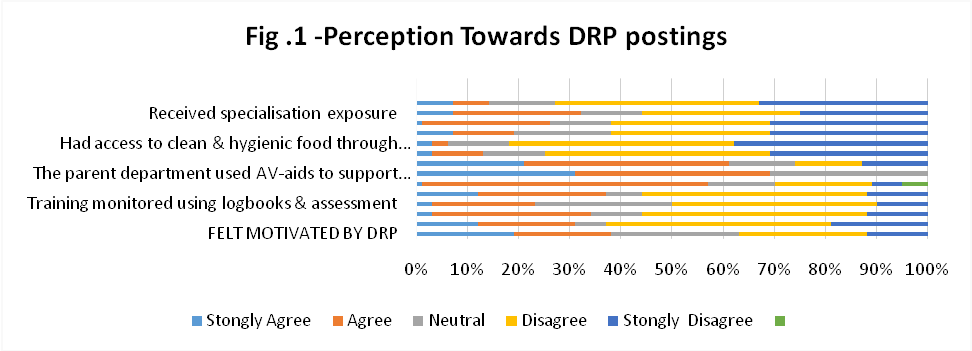
Fig. 1: Perception towards DRP postings
RESULTS
Data was collected and analyzed using Microsoft Excel and SPSS version 24. A total of 158 postgraduate students participated, including 98 second-year and 60 third-year students. Among second-and third-year students, males constituted 55% and 56%, and females 45% and 44%, respectively. Students were from various departments: Anatomy (5), Biochemistry (2), Physiology (4), Pharmacology (7), Pathology (8), Microbiology (22), Preventive and Community Medicine (6), Anaesthesiology (12), Dermatology (8), Forensic Medicine (4), General Medicine (14), General Surgery (16), Obstetrics and Gynaecology (48), Ophthalmology (6), ENT (6), Orthopaedics (6), Paediatrics (8), Psychiatry (4), and Radiodiagnosis (24). The majority of respondents expressed a not satisfied towards DRP postings.
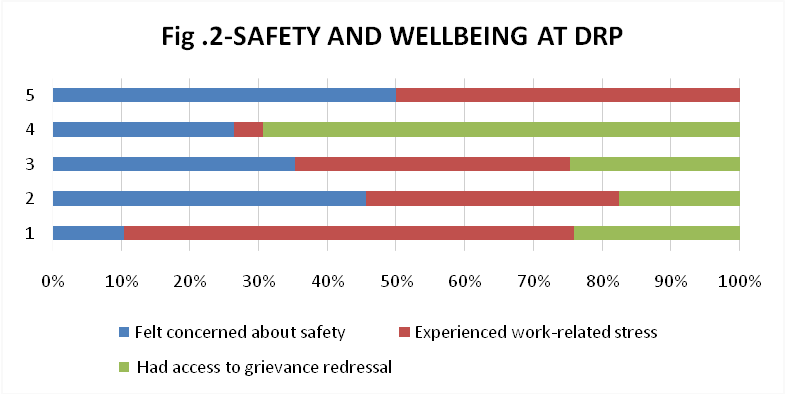
Fig. 2: Safety and wellbeing at DRP
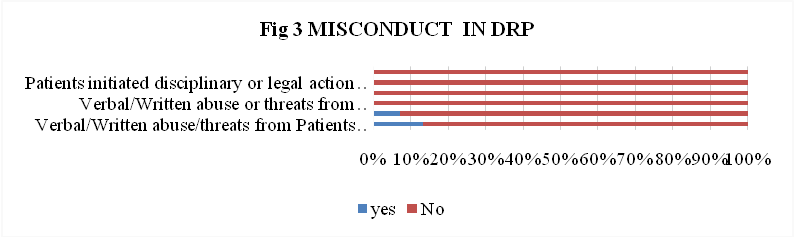
Fig. 3: Misconduct in DRP
DISCUSSION
The DRP, initiated by the National Medical Commission, aims to strengthen rural and urban public health systems by deploying postgraduate residents in under-served areas. It provides exposure to real-world challenges, enhances community engagement, and promotes empathy and leadership.
However, several challenges were identified. Students reported academic setbacks due to reduced exposure to teaching, limited dissertation work time, and disconnection from parent departments. Practical issues such as inadequate accommodation, poor food facilities, lack of supervision, insufficient infrastructure, and heavy clinical loads were commonly cited. These factors negatively impacted the learning experience and training effectiveness. Students not faced any misconduct during the postings. Anjali Goyal et al. [4] (2025) emphasized the need for multi-stakeholder consultations involving faculty and policymakers to resolve issues like accommodation, safety, and unclear work schedules. Standardized policies across institutions may enhance training quality. Kopal Sharma et al. [5] (2025) found that most postgraduate students held negative perceptions of DRP due to logistical challenges and poor communication with parent institutions. Shipra Jain et al. [6] (2023) reported widespread dissatisfaction among district residents regarding accommodation, transport, security, and limited learning opportunities. Khilnani AK et al. [7] and Muthukumar A et al. [8] stated that positive points shared by the similar surveys from other studies included limited working hours, learning to work with minimal resources, friendly seniors and staff, freedom of expression, exploring government settings, being stress‐ free, having the chance to work in a limited facility, and spending some time at home.
CONCLUSION
The District Residency Programme (DRP) is a well-intentioned initiative aimed at strengthening district-level healthcare delivery and enhancing postgraduate training. However, findings from this study indicate that most postgraduate students hold a neutral or less favorable perception of the programme. Challenges such as inadequate accommodation, food, transport, limited academic support, and disconnection from parent institutions affected the overall experience. To improve the effectiveness of the DRP, it is essential to address these operational issues through coordinated efforts involving faculty, policymakers, and health administrators. Ensuring adequate facilities, supervision, and academic continuity can help achieve the intended objectives of the programme and enhance its acceptance among trainees.
FUNDING
Nil
AUTHORS CONTRIBUTIONS
All authors have contributed equally
CONFLICT OF INTERESTS
Declared none
REFERENCES
Gazette of India: Extraordinary. Board of governors in supersession of Medical Council of India notification. Gazette of India: extraordinary; 2020. Available from: https://www.nmc.org.in/activitiwebclient/open/getdocument?path=/documents/public/portal/gazette/pgme-18.09.2020.pdf. [Last accessed on 25 Sep 2023].
Kumar R. District medical colleges in India addressing the rural health-care needs. Journal of Surgical Specialties and Rural Practice. 2022;3(3):45-6. doi: 10.4103/jssrp.jssrp_27_22.
Ghosh R. PG medical students must mandatorily undergo 3 mo rural stint to strengthen grass-roots healthcare. Times of India. 2020 Sep 28. Available from: https://timesofindia.indiatimes.com/city/kolkata/pg-medical-studentsmustmandatorily-undergo-3-month-rural-stintstrengthengrassrootshealthcare/amp_articleshow/78367550. [Last accessed on 03 Nov 2023].
Goyal A, Mahajan N, Panat D, Shah C. A survey to assess the effectiveness and utility of the district residency program implemented for the resident doctors. GAIMS J Med Sci. 2025;5(1):136-41. doi: 10.5278/gjms.2025.5.1.340.
Sharma K, Jain M, Sharma J. The district residency programme: perception of postgraduate students at a Tertiary Care Hospital in Jaipur. Natl Med J India. 2025;38(1):20-1. doi: 10.25259/NMJI_1131_2023, PMID 40390347.
Jain S, Garg S, Paliwal A, Fiza B, Shoaib M. Perception of postgraduates towards district residency program: a mixed method study. J Chem Health Risks. 2023;13(6):2960-5. doi: 10.22034/jchr.2023.13.6.2960.
Khilnani AK, Pillai B, Thaddanee R. Postgraduate students’ feedback on district residency program: a cross-sectional study. GAIMS J Med Sci. 2024;4(2):118-22. doi: 10.5281/zenodo.12784262.
Muthukumar A, Menon P, Mane S, Bhawalkar JS. District residency program students' perception. Med J Dr DY Patil Vidyapeeth. 2024 Jul;17(4):927-8. doi: 10.4103/mjdrdypu.mjdrdypu_477_24.