
Int J Curr Pharm Res, Vol 18, Issue 1, 62-64Original Article
EFFECT OF FAMOTIDINE ON HYPOGLYCAEMIC ACTIVITY OF GLIBENCLAMIDE
D. SHEP1, SAM JOHN2, RANJEETA GHOLVE3*, MANISH RAMAVAT4
1Department of Pharmacology, Govt. Medical College, Chhatrapati Sambhajinagar, Maharashtra, India. 2Department of Pharmacology, Dr. Vithalrao Vikhe Patil Foundation's Medical College and Hospital, Ahmednagar, Maharashtra, India. 3Department of Science, Maharaja Agrasen School, Memnagar, Ahmedabad, Gujarat, India. 4Department of Physiology, GMERS Medical College, Gandhinagar, Gujarat, India
*Corresponding author: Ranjeeta Gholve; *Email: ranjeeta729@gmail.com
Received: 10 Oct 2025, Revised and Accepted: 29 Nov 2025
ABSTRACT
Objective: To study the effect of famotidine (H2 receptor antagonist) in combination with Glibenclamide on the blood sugar level in rabbits.
Methods: Six albino rabbits were taken for the study. Glibenclamide was administrated to each rabbit as a single drug therapy on day 1, while was co-administrated with Famotidine to each rabbit as a combinational drug therapy on day 7. Famotidine was administrated to each rabbit from day 2 to day 6 as a single drug therapy. Blood sugar levels were estimated on day 1 and on day 7 at 0, 1, 2, 4, and 6 h.
Results: The mean blood sugar level readings at 0, 1, 2, 4 and 6 h on day 1 were 91.1, 79.7, 70.6, 61.8 and 66.5 mg% and on day 7 were 91.1, 78.5, 69.6, 60.6 and 64.9 mg%, respectively. When blood sugar level on day 1 and 7 were compared, there was. no significant change in any of the readings after co-administration of Glibenclamide and Famotidine.
Conclusion: Famotidine did not produce any significant reduction in Blood sugar level when it was co-administered with glibenclamide
Keywords: Famotidine, Glibenclamide, Hypoglycaemic, Blood sugar
© 2026 The Authors. Published by Innovare Academic Sciences Pvt Ltd. This is an open access article under the CC BY license (https://creativecommons.org/licenses/by/4.0/)
DOI: https://dx.doi.org/10.22159/ijcpr.2026v18i1.8025 Journal homepage: https://innovareacademics.in/journals/index.php/ijcpr
INTRODUCTION
Type 2 diabetes mellitus is a chronic metabolic disorder with increasing prevalence, characterized by impaired insulin secretion and resistance. Sulphonylureas such as Glibenclamide are commonly prescribed but carry the risk of hypoglycaemia [1]. Patients often require polypharmacy, including H2 receptor antagonists for gastrointestinal disorders.
Cimetidine is well known to interact with a number of drugs concurrently administered by inhibiting hepatic microsomal enzymes [2]. Adverse effects due to the interaction of Cimetidine with Theophylline, Phenytoin, Warfarin [3-5] have been reported. Co-administration of Cimetidine has been found to influence the hypoglycaemic activity of glibenclamide as reported in study conducted in rabbits [6]. Famotidine is metabolized by the hepatic cytochrome P450 system, but has minimal inhibitory effects on the metabolism of other drugs, making it less likely to cause drug-drug interactions than cimetidine [7].
Limited data exist regarding its interaction with Glibenclamide. Therefore, this study was conducted to evaluate the effect of Famotidine on Glibenclamide-induced hypoglycaemia in rabbits.
MATERIALS AND METHODS
The study was carried out in the experimental room of the central animal house of Government Medical College, Chhatrapati Sambhajinagar. Six healthy albino rabbits of either sex, weighing between 1.6 and 2.1 kg were used in the study. This experimental study was conducted in accordance with the ethical standards for animal research applicable at the time (1999) and was approved by the Institutional Animal Ethics Committee, Government Medical College, Chhatrapati Sambhajinagar. The CPCSEA guidelines were implemented in subsequent years.
Rabbits were kept for fasting overnight for 18 h. Water was given at libitum and rabbits were kept at temp between 30-33 °C. For oral feeding rabbits, a special rabbit holding box and mouth gag with feeding tube was used. During 7 d of study period, each rabbit was given Glibenclamide and Famotidine as single drug therapy and also as combination therapy as shown below.
Day 1: Glibenclamide
Day 2-6: Famotidine
Day 7: Glibenclamide+Famotidine
Doses of all the drugs were calculated from Fundamentals of Experimental Pharmacology by Ghosh [8]. About 1 ml of blood was collected from marginal ear vein of the rabbits for blood glucose estimation on day 1 and on day 7 at 0, 1, 2, 4, and 6 h. Blood sugar levels were estimated by modified Somogy’s method and expressed as milligram per 100 ml (mg %).
Statistical analysis
Mean blood sugar levels were expressed as milligram per 100 ml±standard Deviation (mg %±SD). The Student’s t-test was used to test the significance of the difference between treated groups for the blood sugar level on day 1 and day 7 at 0, 1, 2, 4 and 6 h in each treated group and taken as significant at p<0.05.
Table 1: Effect of famotidine on hypoglycaemic activity of glibenclamide in rabbits
| Drug | Mean blood sugar level (mg %±SD) | ||||
| 0 h | 1 h | 2 h | 4 h | 6 h | |
| Glibenclamide (Day 1) (n=6) | 91.1±2.03 | 79.7±1.97 | 70.6±2.76 | 61.8±1.90 | 66.5±2.41 |
| Glibenclamide+Famotidine (Day 7) (n=6) | 91.1±0.97 | 78.5±0.95 | 69.6±3.14 | 60.6±2.01 | 64.9±1.35 |
| P-value | >0.05 | >0.05 | >0.05 | >0.05 | >0.05 |
Value were expressed in mean±SD, Significant at P<0.05
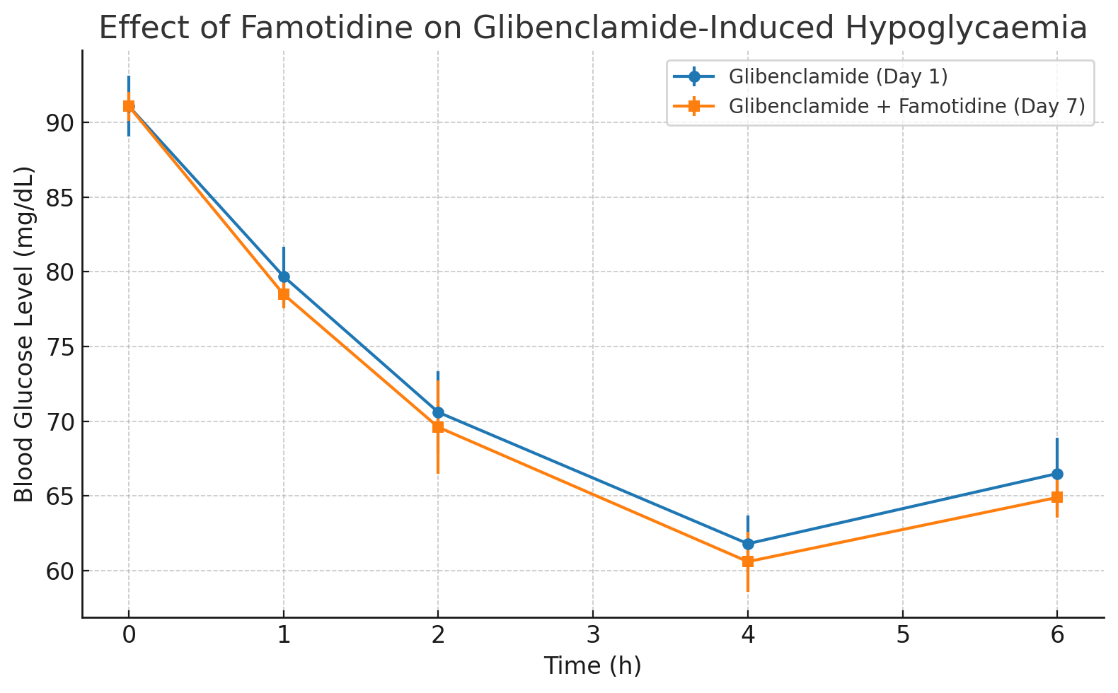
Fig. 1: Mean blood glucose levels (mg%) after glibenclamide alone and with famotidine
RESULTS
The mean blood sugar level readings at 0, 1, 2, 4 and 6 h on day 1 were 91.1, 79.7, 70.6, 61.8 and 66.5 mg% after administration of glibenclamide and on day 7 were 91.1, 78.5, 69.6, 60.6 and 64.9 mg% after administration of Glibenclamide+Famotidine respectively. When mean blood sugar level reading on day 1 and day 7 were compared, there was no significant reduction at 0,1, 2, 4 and 6 h after co-administration of Glibenclamide and Famotidine.
DISCUSSION
This study shows Famotidine did not alter the hypoglycaemic effect of Glibenclamide. In contrast, Cimetidine and Ranitidine potentiates sulphonylurea hypoglycaemia due to P450 inhibition [9, 10]. Famotidine is metabolized by the hepatic cytochrome P450 system, but has minimal inhibitory effects on the metabolism of other drugs, making it less likely to cause drug-drug interactions than cimetidine [7].
No significant effects were found on the biologic disposition of theophylline, warfarin, and other compounds metabolized by the liver cytochrome P450 enzyme system when they are given concomitantly with famotidine [11]. In contrast to cimetidine and ranitidine, famotidine, which possesses a thiazole ring structure, demonstrates minimal or no influence on the hypoglycaemic response to sulfonylureas such as glibenclamide. This lack of interaction may be because, unlike cimetidine and ranitidine, famotidine has a very low affinity for and does not significantly inhibit the hepatic cytochrome P450 (CYP450) enzyme system, which is responsible for the metabolism of many drugs, including sulfonylureas.
Further study published in Journal of clinical pharmacology confirms that therapeutic doses of famotidine do not impair diazepam and desmethyldiazepam kinetics, suggesting that there is no significant kinetic interaction when diazepam and famotidine are administered concurrently [12]. Our results align with this pharmacological profile.
Recent advances in pharmacogenetics highlight the importance of genetic variability in drug metabolism when multiple medications are prescribed. Genetic polymorphisms incytochrome P450 enzymes, particularly CYP2C9, is known to influence the metabolism of sulphonylureas and other concomitant drugs [13]. Incorporating pharmacogenetic screening before initiating polypharmacy in chronic conditions could help clinicians to predict potential drug–drug interactions, optimize therapeutic efficacy, and minimize adverse effects. Organizations such as Indus Health Plus are actively advancing this field by offering pharmacogenetic testing services, enabling a more personalized approach to medication management and reducing the risk of adverse drug interactions in clinical practice.
CONCLUSION
The co-administration of famotidine with glibenclamide did not result in a statistically significant reduction in blood glucose levels compared to glibenclamide alone. This finding suggests that famotidine does not potentiate the hypoglycaemic effect of glibenclamide, indicating an absence of clinically relevant pharmacokinetic or pharmacodynamic interaction between the two agents.
ACKNOWLEDGMENT
The authors are grateful to Government Medical College, Chhatrapati Sambhajinagar and Pharmacology Department staff for their cooperation throughout this study.
AUTHORS CONTRIBUTIONS
All authors have contributed equally
CONFLICTS OF INTERESTS
The authors declare that they have no conflicts of interest.
REFERENCES
Van Dalem J, Brouwers MC, Stehouwer CD, Krings A, Leufkens HG, Driessen JH. Risk of hypoglycaemia in users of sulphonylureas compared with metformin in relation to renal function and sulphonylurea metabolite group: population-based cohort study. BMJ. 2016;354:i3625. doi: 10.1136/bmj.i3625.
Lin JH, Chremos AN, Chiou R, Yeh KC, Williams R. Comparative effect of famotidine and cimetidine on the pharmacokinetics of theophylline in normal volunteers. Br J Clin Pharmacol. 1987;24(5):669-72. doi: 10.1111/j.1365-2125.1987.tb03228.x, PMID 2893637.
Vestal RE, Thummel KE, Musser B, Mercer GD. Cimetidine inhibits theophylline clearance in patients with chronic obstructive pulmonary disease: a study using stable isotope methodology during multiple oral dose administration. Br J Clin Pharmacol. 1983;15(4):411-8. doi: 10.1111/j.1365-2125.1983.tb01523.x, PMID 6849776.
Hetzel DJ, Bochner F, Hallpike JF, Shearman DJ, Hann CS. Cimetidine interaction with phenytoin. Br Med J (Clin Res Ed). 1981;282(6275):1512. doi: 10.1136/bmj.282.6275.1512, PMID 6786537.
Hetzel D, Birkett D, Miners J. Cimetidine interaction with warfarin. Lancet. 1979;2(8143):639. doi: 10.1016/s0140-6736(79)91701-x, PMID 90304.
Shep D, Phatak RS, Sidhu N, Gade P. Comparative effects of cimetidine on hypoglycaemic activity of glibenclamide in rabbits. Pravara Med Rev. 2019;11(4):5-8.
LiverTox: Clinical and Research Information on Drug-Induced Liver Injury. Famotidine. Bethesda (MD): National Institute of Diabetes and Digestive and Kidney Diseases (NIH); 2012. Available from: https://www.ncbi.nlm.nih.gov/books/NBK548228/. [Last accessed on 25 Jan 2018].
Ghosh. Fundamental of experimental pharmacology. 2nd ed; 2008. p. 154-5.
Ranjeeta Gholve D, Shep, Prakashchandra Gade, Manish Ramavat. A study on drug-drug interaction between glipizide and cimetidine in rabbits. Int J Curr Pharm Res. 2021;13(2):17-8. doi: 10.22159/ijcpr.2021v13i2.41545.
Gholve R, John S, Shep D, Ramavat M, effect of ranitidine on hypoglycaemic activity of glipizide in rabbits. Int J Curr Pharm Res. 2024;16(5):76-7. doi: 10.22159/ijcpr.2024v16i5.5069.
Chremos AN. Pharmacodynamics of famotidine in humans. Am J Med. 1986;81(4B):3-7. doi: 10.1016/0002-9343(86)90593-0, PMID 2877572.
Locniskar A, Greenblatt DJ, Harmatz JS, Zinny MA, Shader RI. Interaction of diazepam with famotidine and cimetidine two H2-receptor antagonists. J Clin Pharmacol. 1986;26(4):299-303. doi: 10.1002/j.1552-4604.1986.tb03527.x, PMID 2871051.
Daly AK. Pharmacogenetics of drug metabolism. Pharmacol Ther. 2017;175:148-62. doi: 10.1016/j.pharmthera.2017.02.010.