
Int J Curr Pharm Res, Vol 18, Issue 2, 118-121Original Article
IMPACT OF STRUCTURED PEER-ASSISTED LEARNING ON ANATOMY TOPICS: A JIGSAW METHOD APPROACH
PARIMALA SIRIKONDA1, MOHD IMTESAL ALI ZISHAAN2, MARIYA3, NIVEDITHA SIRIKONDA4*
1,2Department of Anatomy, Government Medical College, Mahabubnagar, Telangana, India. 3Government Medical College, Maheshwaram, Telangana, India. 4BDS, Centerville Pediatric Dentistry, USA
Email: pari.siri@gmail.com
Received: 18 Nov 2025, Revised and Accepted: 07 Jan 2026
ABSTRACT
Objective: To evaluate the effectiveness of structured peer-assisted learning using the Jigsaw method in improving understanding, retention, teamwork, communication skills, and overall academic performance among Phase-I MBBS students in anatomy.
Methods: A pre-test and post-test interventional study was conducted among 150 Phase-I MBBS students in the Department of Anatomy, Government Medical College, Mahabubnagar. Students participated in a structured Jigsaw learning session covering selected anatomy topics. A 15-item multiple-choice questionnaire was administered before and after the intervention. Scores were analyzed using paired statistical methods.
Results: The mean pre-test score was 7.0±2.1, which improved significantly to 14.0±1.3 in the post-test. The improvement was statistically significant (p<0.0001) with a very large effect size (Cohen’s d = 1.85). There was a marked reduction in low scorers and a substantial increase in high achievers.
Conclusion: Structured peer-assisted learning using the Jigsaw method significantly enhanced comprehension, retention, communication skills, teamwork, confidence, and overall academic performance among MBBS Phase-I students. The method aligns well with CBME objectives and represents an effective student-centered teaching strategy in anatomy education.
Keywords: Jigsaw Method, Anatomy education, Knowledge retention
© 2026 The Authors. Published by Innovare Academic Sciences Pvt Ltd. This is an open access article under the CC BY license (https://creativecommons.org/licenses/by/4.0/)
DOI: https://dx.doi.org/10.22159/ijcpr.2026v18i2.8076 Journal homepage: https://innovareacademics.in/journals/index.php/ijcpr
INTRODUCTION
Contemporary medical education increasingly emphasizes learner-centered approaches that promote active participation, collaboration, and shared responsibility for learning, Cooperative learning strategies have emerged as effective tools for improving engagement and academic outcomes, particularly in content-heavy subjects such as anatomy.
The Jigsaw teaching technique, developed by Aronson [1], is a structured cooperative learning method in which students become “experts” on subtopics and subsequently teach their peers. This approach promotes positive interdependence, individual accountability, and enhanced communication skills. By requiring students to reorganize and verbalize information, peer teaching strengthens conceptual clarity and long-term retention [2-4].
In medical education, jigsaw learning has been shown to improve understanding of complex concepts, reduce learner anxiety, and foster teamwork and professional communication skills [5, 6]. Despite concerns regarding variability in peer teaching quality, structured facilitation and clear objectives can mitigate these limitations. This study was undertaken to assess the effectiveness of the Jigsaw method in anatomy teaching under the CBME framework.
MATERIALS AND METHODS
Study design and participants
A pre-test and post-test interventional study was conducted in the Department of Anatomy, Government Medical College, Mahabubnagar. The study included 150 Phase-I MBBS students after obtaining institutional approval.
Study procedure
A structured Jigsaw learning session was conducted as follows:
A 15-item multiple-choice pre-test was administered to assess baseline knowledge.
Students were divided into small home groups, each containing 5–6 students.
Each home group member was assigned a specific subtopic.
Students with the same subtopic formed expert groups and studied their assigned content (bones, joints, muscles, nerves, vessels, and organ systems) for 30 min under faculty supervision.
Students returned to their respective home groups and taught their subtopics to peers.
After completion of peer teaching, the same 15-item questionnaire was administered as a post-test using Google Forms.
Total duration: 2 h and 10 min.
DISCUSSION
The present study demonstrates that structured peer-assisted learning using the Jigsaw method leads to significant improvement in anatomy learning outcomes among Phase-I MBBS students. The substantial increase in post-test scores, large effect size, and reduction in low performers indicate strong educational effectiveness.
These findings are consistent with previous studies that reported improved conceptual clarity, enhanced student engagement, reduced failure rates, and better retention through cooperative learning strategies [7-9]. The present study further supports the role of Jigsaw learning in developing communication skills, teamwork, and learner confidence, which are essential competencies under CBME.
Fig. 1: Comparison of pre-test and post-test mean scores among phase-I MBBS students
Table 1: Comparison of pre-test and post-test scores
| Parameter | Pre-test | Post-test |
| Mean score | 7.0 | 14.0 |
| Standard deviation | ±2.1 | ±1.3 |
| Median | 7 | 12 |
| Minimum score | 3 | 9 |
| Maximum score | 12 | 15 |
Table 2: Distribution of student performance before and after jigsaw learning
| Performance category | Pre-test observation | Post-test observation |
| Low scorers (<5 marks) | Many students | Very few students |
| Average scorers (5–9 marks) | Majority of students | Few students |
| High scorers (>10 marks) | Very few students | Majority of students |
Table 3: Detailed comparison of learning outcomes
| S. No. | Parameter assessed | Pre-test observation | Post-test observation | Interpretation |
| 1 | Score distribution | 4–8 marks | 10–14 marks | Significant improvement |
| 2 | Mode | 6–7 | 12–14 | Shift toward higher scores |
| 3 | Low scorers | High proportion | Minimal | Weak learners improved |
| 4 | High scorers | Few | Majority | Strong achievers increased |
| 5 | Score skewness | Left-skewed | Right-skewed | Positive shift |
| 6 | Median score | 7 | 12 | Improved central tendency |
| 7 | Overall performance | Below average | High performing | Clear academic gain |
Table 4: Statistical analysis of scores
| Statistical parameter | Value |
| Pre-test mean±SD | 7.0±2.1 |
| Post-test mean±SD | 14.0±1.3 |
| mean improvement | 100% |
| Median (Pre → Post) | 7 → 12 |
| Paired t-test | p<0.0001 |
| Effect size (Cohen’s d) | 1.85 (Very large) |
Table 5: Comparison with previous studies
| S. No. | Authors | Key findings | Comparison with present study |
| 1 | Sengupta P, Sharma A, Das N(7) | 35% improvement with Jigsaw method | Higher improvement (46.6%) observed |
| 2 | Bhutia Tenzing Norbu, Tamang Sonam (8) | Improved clarity and engagement | Similar findings |
| 3 | Freeman Scott, Eddy Sarah L, McDonough Miles, Smith Michelle K, Okoroafor Nnadozie, Jordt Hannah, Wenderoth Mary Pat (9) | Reduced failure rates with active learning | Low scorers reduced significantly |
| 4 | Haq Imran, Rose Jenny, Miller Andy (6) | Improved retention and understanding | Strong post-test scores |
| 5 | Johnson David W, Johnson Roger T | Improved teamwork and communication | Comparable improvement |
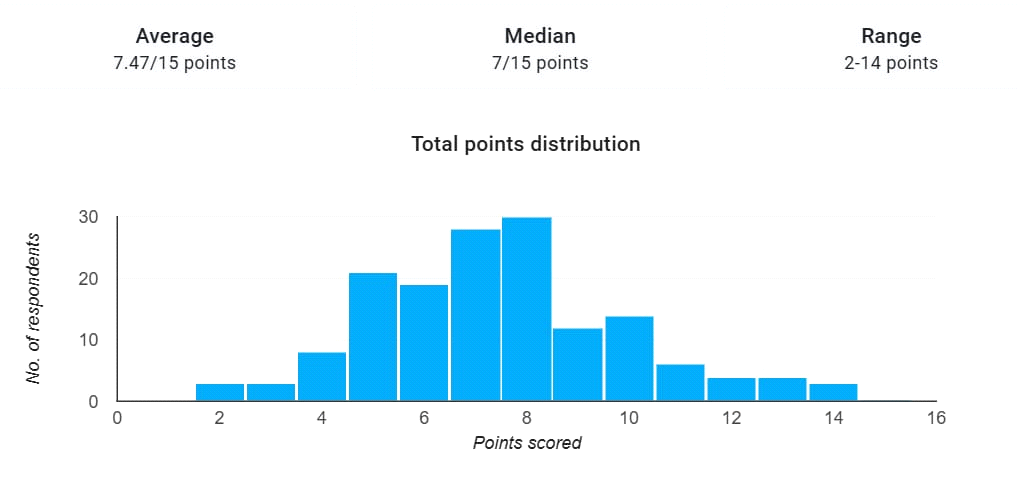
Fig. 2: Distribution of pre-test scores showing baseline knowledge levels
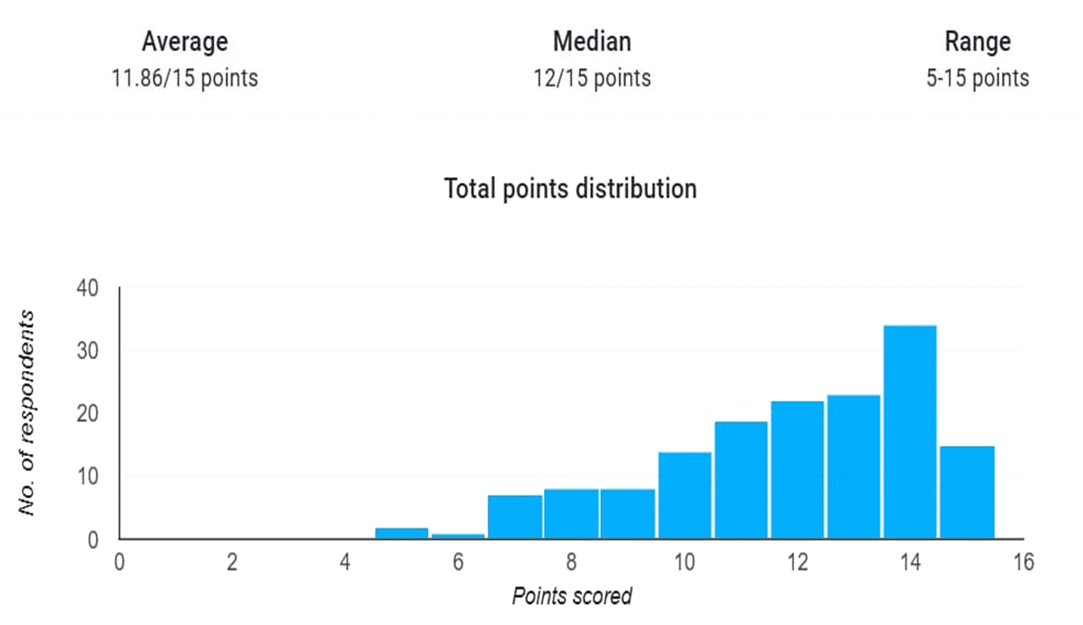
Fig. 3: Distribution of post-test scores demonstrating learning gain after jigsaw intervention
Table 6: Interpretation of learning gains
| Parameter | Pre-test status | Post-test status | Interpretation |
| Confidence | Low | High | Improved communication |
| Teamwork | Minimal | Strong | Enhanced collaboration |
| Understanding | Fragmented | Clear | Better mastery |
| Engagement | Passive | Active | Increased involvement |
| Retention | Weak | Strong | Sustained learning |
CONCLUSION
The structured peer-assisted Jigsaw learning method significantly improved understanding, retention, communication skills, teamwork, and academic performance among Phase-I MBBS students in anatomy. The method effectively supports CBME objectives and provides an inclusive, student-centered learning environment beneficial to learners of all performance levels.
LIMITATIONS
Single-institution study
Selected anatomy topics only
Absence of a control group
No long-term follow-up assessment
ACKNOWLEDGEMENT
The authors acknowledge the cooperation of faculty members and students of Government Medical College, Mahabubnagar.
FUNDING
No external funding received.
AUTHORS CONTRIBUTIONS
All authors have contributed equally
CONFLICT OF INTERESTS
Declared none
REFERENCES
Aronson E. The jigsaw classroom. Cambridge: Harvard University Press; 1971.
Dhull P, Verma G. Jigsaw teaching technique for teaching science. Int J Res Anal Rev. 2019;6(2):808-14.
Phillips J, Fusco J. Using the jigsaw technique to teach clinical controversy in a clinical skills course. Am J Pharm Educ. 2015;79(6):90. doi: 10.5688/ajpe79690, PMID 26430277.
Hidayu N, Suhaimee N, Indriyani I. Cooperative learning using jigsaw method to improve student activity. Int J Recent Sci Res. 2017;4(1):33-7.
Walker S, Olvet D, Chandran L. The jigsaw technique of peer teaching and learning in medicine. MedEdPublish. 2015;6(1):1-9.
Haq I, Rose J, Miller A. Peer-assisted learning: a systematic review. Adv Physiol Educ. 2017;41(4):485-90.
Sengupta P, Sharma A, Das N. Efficacy of jigsaw teaching in anatomy education. Anat Sci Educ. 2020;13(2):254-60.
Norbu BT, Sonam T. Collaborative learning methods in anatomy. Indian J Anat. 2019;8(3):150-5.
Freeman S, Eddy SL, McDonough M, Smith MK, Okoroafor N, Jordt H. Active learning increases student performance in science engineering and mathematics. Proc Natl Acad Sci USA. 2014;111(23):8410-5. doi: 10.1073/pnas.1319030111, PMID 24821756.