
Int J Pharm Pharm Sci, Vol 7, Issue 11, 172-175Original Article
SYNTHESIS, CHARACTERIZATION AND ELECTROCHEMICAL INVESTIGATION OF NOVEL 17-MEMBERED DIOXADIAZA NAPTHALDEHYDE BASED MACROCYCLIC LIGAND AND ITS COMPLEXES OF Co (III), Ni (II) AND Cu (II) PERCHLORATE IONS
A. N. PAUL ANGELO*, L. RAKESH SHARMAa, K. N. SABHARWALb
aResearch Scholar, Department of Chemistry, St. Joseph's College (Autonomous), Tiruchirappalli 620002, bScientist, Chemistry Group, Indira Gandhi Centre for Atomic Research, Kalpakkam, Tamil Nadu 603102
Email: vrithiya@gmail.com
Received: 03 Aug 2015 Revised and Accepted: 22 Sep 2015
ABSTRACT
Objective: The objective of this research is to synthesis hitherto, novel unreported [17]-membered dioxadiaza napthaldehyde based macrocyclic ligand (L) and to synthesize its Co (III), Ni (II) and Cu (II) metal ion complexes.
Methods: The synthesis of the ligand has been accomplished by two different synthetic routes each involving two stages. 2-Hydroxy-1-Napthaldehyde in the presence of potassium carbonate was treated with α,α'-dibromo-m-xylene to yield the dial derivative (I). The dial derivative (I) was further made to undergo Schiff base condensation with 1,2-diaminobenzene to yield the bright yellow macrocycle (L) in good yield. In the second method the Schiff base condensed product Napthaloph was synthesized and allowed to undergo Williamson's condensation with α,α'-dibromo-m-xylene to yield the ligand (L).
Results: The ligand and its complexes were characterized by elemental analysis, electronic spectroscopy, IR, Conductivity measurements, EPR, magnetic susceptibility, 1H NMR and MS. The neutral seventeen membered tetradentate dioxadiaza ligand (L) readily complexes with Co(III), Ni(II) and Cu(II) perchlorate salts in 1:1 mole ratio to yield complexes of formulae [Co(L)X2]ClO4, [Ni(L)X2], [Cu(L)X]ClO4, (X = Cl-, Br-and NO3-). The complexes were also synthesized by the metal template method. The yield of the template procedure was found to be greater than the non-template method.
Conclusion: A hitherto 2, 10-dioxa-21,29-diaza-heptacyclo-[29.4.2.1[4,8].0[1,32].0[11,20].0[14,19].0[23,28].0[32,37]]-tetraconta-4, 6, 8, 11, 13, 15, 17, 19, 21, 23, 25, 27, 29, 31, 33, 35, 37, 39-octatecaene. The [17]-membered tetradentate dioxadiaza macrocycle (L) was found to accommodate Co3+, Ni2+, and Cu2+ions with ease due to the presence of flexible alkyl groups. Further studies with the inner-transition metal ions will be highly informative in understanding the coordinating capabilities of lanthanides and actinides.
Keywords:The synthesis and characterization of dioxadiaza macrocyclic ligand and its complexes of Co(III), Ni(II) and Cu(II) perchlorate complexes.
© 2016 The Authors. Published by Innovare Academic Sciences Pvt Ltd. This is an open access article under the CC BY license (http://creativecommons.org/licenses/by/4.0/)
INTRODUCTION
The design and synthesis of macrocyclic complexes [1, 2] initially has lured many a scientist owing to their significance in serving as biological mimics [3-7]. The synthetic macrocyclic complexes mimic some natural accruing macrocyclic complexes [8] resemblance with natural macrocyclic like metalloproteins, porphyrins and cobalamine [9, 10]. The transition metal macrocyclic complexes are active part of metaloenzyme proteins and coenzymes like haemoglophin, myoglobin [11-14]. Lanthanide macrocyclic complexes involving Gd and Eu are extensively used as NMR shift reagents [15]. Identification and realization of the applications of macrocyclic ligands and their transition and inner-transition metal complexes as base transfer catalyst and in biological probe studies [16, 17]have opened up new avenues of exploring their potency in various other fields recently the Napthaldehyde based Schiff bases are gaining significance due to their sequestrating properties towards transition metals [18, 19]. The presence of azomethine group has been reported to possess remarkable antibacterial, antifungal, anticancer and antimalarial activities [20, 21]. In order to understand the involvement of azomethine groups in the above said properties, we have reported the synthesis and spectral characterization of hitherto unreported new 17-membered napthaldehyde based dioxadiazatetra dentate macrocyclic ligand (L), and its Co (III), Ni (II) and Cu (II) perchlorate complexes.
MATERIALS AND METHODS
All the chemicals used in this study were of Analar grade. Metal salts were purchased from Merck and were used as such as received. Elemental analysis was carried out on Elementarvario EL III-Germany. 1H NMR spectrum was recorded used to Bruker model 4276. FT IR spectra recorded on Perkin Elmer on KBr pellets in the range of 4000 to 400 cm-1. The electronic spectrum recorded on Lambda 35 in the range of 200 to 800 nm using 10-3M concentration solution in DMF. NMR spectrum was recorded using Bruker model 4276. The new dialdehyde was synthesis from 2-hydroxyl-1-napthaldehyde and α, α-dibromo-m-xylene in basic medium using potassium carbonate under reported procedure [22].
Synthesis of dialdehyde
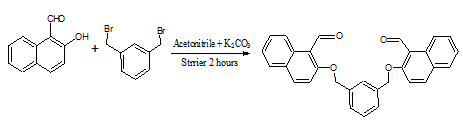
To a solution of (1g, 5 mmol) of 2-hydroxy-1-napthaldehyde in 15 mL of acetonitrile was added (0.345g, 2.5 mmol) of K2CO3 and the resulting solution was stirrer for 30 min under thermostat condition at 60 °C wherein a bright yellow color solution was obtained. To this stirring solution was added a solution of (0.66g, 2.5 mmol) of α,α’-dibromo-m-xylene in 5 ml of acetonitrile in one lot. The resulting pale yellow solution was stirred until the solution decolorized and on addition of 20 ml of cold water it yielded a spongy white dialdehyde product. The spongy product was filtered using sintered crucible. Yield is 71%, m. pt 164 °C. Anal. Cal. (C30H24O4), C(33.37), H(5.05), N(5.40), O(56.08) Found: C(33.31), H(5.02), N(5.37), O(56.04). IR (KBr Pellets) (C=O) 1665 cm-1, (C=C)aro 1581 cm-1, (C-O) 1235 cm-1. The synthesis of the dialdehyde is depicted in Scheme.1.
Scheme 1
Synthesis of macrocyclic ligand (L)
To a ethanolic solution of (1g, 0.4 mmol) of the dialdyhyde in 10 ml of ethanol was added a solution 1,2-diamino benzene (0.8g, 0.4 mmol) in 10 ml of ethanol solution under gradual addition in drops using a dropping funnel over 30 min. The resulting pale yellow turbid solution was refluxed for 4h wherein a clear bright yellow solution was obtained, on standing the solution to room temperature a bright yellow colored product separated out. Yield: 89% m. pt: 178 °C. Anal. Cal. (C36H26N2O2), C(83.37), H(5.05), N(5.40), O(6.17). IR (KBr Pellets) (C=N) 1602 cm-1, (C=C)aro 1510 cm-1, (C-O) 1250 cm-1. The synthesis of the overall ligand is depicted in Scheme 2.
Scheme 2
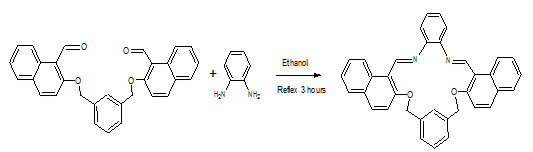
2,10-dioxa-21,29-diaza-heptacyclo-[29.4.2.14,8. 01,32. 011,20. 014,19. 023,28. 032,37]-tetraconta-4,6,8,11, 13,15, 17, 19, 21, 23, 25, 27, 29, 31, 33, 35, 37, 39-octatecaene.
Synthesis of complexes
General procedure for the synthesis of metal complexes of ligand (L)
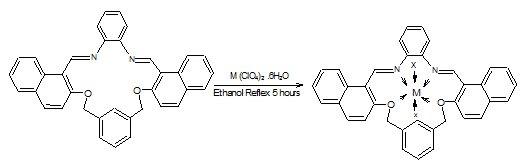
To a refluxing solution of a ligand (10 mmol) in 20 ml of absolute alcohol was added an equivalent mole ratio of the corresponding perchlorate salts M(ClO4) 6H2O (10 mmol) where in (M= Co, Ni, Cu). To this refluxing metal perchlorate solution of the ligand (L) was added the corresponding axial monoanionic ligand X in appropriate mole ratio, (X= Br-, Cland NO3-) on continuing the reflux for 30 min yielded macrocyclic complexes in good yield. The complexes of varying colour and nature were isolated from the mother liquor owing to the sparingly soluble nature. The complexes were filtered and washed repeatedly with diethyl ether and dried over anhydrous CaCl2 under vacuum condition. No further purification carried out as the micro crystalline colored complexes separated readily, in pure condition. The Scheme 3 depicted the nature of bonding exhibited by the ligand.
Scheme 3
RESULTS AND DISCUSSION
Synthesis and characterization of the ligand (L)
The dioxadiazanapthaldehyde based tetradentate macrocyclic was synthesized by two different methods. The first method involves the Schiff’s base condensation of the napthaldehyde and o-phenylenediammine in 2:1 mole ratio in acetonitrile, to yield the Schiff; s base condensed product (Napthaloph). The azomethine derivative was further reacted with α,α’-dibromo-m-xylene under Williamsons condensation in 1:1 mole ratio to yield the 17-membered N2O2 macrocyclic ligand(L). The second method involves the Williamsons’ condensation reaction of napthaldehyde and α,α’-dibromo-m-xylene in 2:1 mole ratio to yield the dial derivative(I), further the dial derivative is made to undergo schiff’s base condensation with 1,2-diamino benzene to yield the 17-membered macrocycle (L). The ligand isolated readily from the solution due to its sparingly soluble nature. The tetradentate dioxadiaza macrocyclic ligand (L), was characterized by elemental analysis, electronic spectroscopy, IR, 1H, 13C NMR, CIMS and Cyclic voltammetric studies. The elemental analysis was in good agreement with the experimental and theoretical value, which ensures the formation of the macrocyclic ligand. The presence of aldehyde peak at 1664 cm-1 in the dial derivative(I) and the absence of the sharp υ(OH) peak at 3550 cm-1 endures the formation of the dial intermediate(I) [23]. The disappearance of the υ(C=O) stretching frequency at 1664 cm-1 and the appearance of the new peak at 1602 cm-1 has been assigned to υ(C=N) stretching frequency [24]. This confirms the formation of the macrocyclic ligand. The 1H NMR spectrum of the dial derivative(I) exhibits a sharp singlet at 11 ppm assigned to the aldehydic protons, the multiplet centered around 7.2 to 8.1 ppm has been attributed to the aromatic protons from both naphthalene and benzene moieties. The four proton sharp singlet appearing at 5.4 ppm has been assigned to the methylene protons. The 13C NMR of dial derivative (I) exhibits a sharp peak at 78 ppm with 70% intensity which has been assigned to the methylenic carbons, the sharp peak of weak intensity observed at 192 ppm has been assigned to aldehydic carbon and the medium intensity peaks centered around 112-138 ppm has been attributed to the aromatic carbon atoms pertaining to benzene and naphthalene moieties [25]. The mass spectrum of the dial derivative(I) exhibited the molecular base peak at 443 m/z of low intensity confirming the formation of the dioxaadiaza tetra dentate macrocyclic ligand. The chemical ionization mass spectrum of the ligand exhibited a [M+H]+molecular ion peak at 519 m/e value. The CHN analysis of the ligand is in good agreement of the observed value.
Characterization of the Co(III), Ni(II) and Cu(II) complexes of the ligand (L)
The perchlorate complexes of the macrocyclic ligand(L) were synthesized both by the reaction of the preformed ligand and metal perchlorate in 1:1 mole ratio in ethanol, and by the metal template method wherein the precursors and the corresponding metal perchlorates were made to react simultaneously in one pot synthesis method. The preformed ligand and metal perchlorate yielded better results than the template procedure. The varying coloured complexes obtained were characterized using elemental analysis, molar conductance, UV-vis spectroscopy, FAB-MS magnetic susceptibility and cyclic voltammetry. The infrared spectral data of the ligand and the complexes are tabulated in table-1. On complex formation the υ(C=N) peak which appears at 1602 cm-1 in the pure ligand has been shifted towards lower frequencies which is in good agreement with the coordination of the azomethine group with the central metal ions. The occurrence of two types of υ (C-O) stretching frequencies corresponding to υ(C-O) aromatic and υ(C-O) aliphatic nature ensures the coordination of the two oxa groups with the central metal ions. The ligand is found to act as neutral dioxadiaza tetradentate ligand. The stretching due to υ(C=C) occurs within the range of 1508-1515 cm-1 in all the complexes. All the perchlorate complexes exhibit υ(ClO4) stretching pertaining to free ionic perchlorate groups around 1059-1085 cm-1 in all the complexes [26-28]. The molar conductance values of the complexes reveal that the complexes exist as both neutral entities and 1:1 type of electrolytes. The electronic spectral data reveal that all the metal ions exist in their usual oxidation states, the cobalt (III) complexes in which cobalt acquires d6 state and is expected to exhibit an single electronic transition, and it is observed so indicating that the cobalt ion is in 3+oxidation state. [29-31] The 1H NMR spectrum of the ligand (L) exhibits a multiplet around 7.1 ppm to 8.1 ppm assignable to the aromatic protons of Napthaldehyde and benzene groups, the singlet of medium intensity occurring at 9.4 ppm has been assigned to azomethine protons in the macrocycle. The unsymmetrical triplet occurring around 1.6 to 2.4 has been assigned to methylene protons. The singlet peak of medium intensity occurring at 15.1 ppm may be assigned to the hydrogen bond that can be formed due to a transfer of proton from the macrocycle moiety that can form hydrogen bond between the two oxa donors in the macrocycle.
Table 1: Infrared Spectral data of the ligand (L) and its transition metal Complexes
Compound |
υ (C=N) (cm-1) |
υ (C=C) (cm-1) |
υ (C-O)Aro (cm-1) |
υ (C-O)Ali (cm-1) |
ClO4- |
Ligand |
1602 |
1510 |
1250 |
1080 |
1071 |
[Co(L)Cl2] ClO4 |
1586 |
1510 |
1239 |
1071 |
1073 |
[Co(L)Br2] ClO4 |
1588 |
1510 |
1240 |
1064 |
1064 |
[Co(L)(NO3)2]ClO4 |
1582 |
1510 |
1238 |
1076 |
1076 |
[Ni(L)Cl2] |
1186 |
1515 |
1240 |
1078 |
1078 |
[Ni(L)Br2] |
1585 |
1508 |
1241 |
1061 |
1061 |
[Ni(L)(NO3)2] |
1586 |
1511 |
1240 |
1065 |
1084 |
[Cu(L)Cl] ClO4 |
1599 |
1515 |
1245 |
1060 |
1085 |
[Cu(L)Br] ClO4 |
1595 |
1512 |
1240 |
1070 |
1083 |
[Cu(L)NO3] ClO4 |
1588 |
1514 |
1239 |
1059 |
1059 |
Table 2: Physical properties of M–Dial perchlorate complexes
Name of the complexes |
Color |
Molecular weight |
Yield % |
Molar conductance (mho cm2 mol-1) mho |
Nature of the electrolyte |
[Co(L)Cl2] ClO4 |
Light Brown |
725.63 |
71 |
67 |
1:1 |
[Co(L)Br2] ClO4 |
Black |
814.53 |
73 |
72 |
1:1 |
[Co(L)(NO3)2] ClO4 |
Dark Brown |
776.73 |
74 |
76 |
1:1 |
[Ni(L)Cl2] |
Grey Color |
725.39 |
81 |
37 |
Neutral |
[Ni(L)Br2] |
Grey Color |
746.19 |
83 |
35 |
Neutral |
[Ni(L)(NO3)2] |
Grey Color |
846.29 |
80 |
39 |
Neutral |
[Cu(L)Cl] ClO4 |
Light Brown |
679.75 |
77 |
72 |
1:1 |
[Cu(L)Br] ClO4 |
Brown |
724.20 |
78 |
67 |
1:1 |
[Cu(L)NO3] ClO4 |
Dirty White |
737.34 |
74 |
76 |
1:1 |
Table 3: Electronic spectral data of the ligands and its complexes
Complexes |
Frequency Range (cm-1) |
[Co(L)Cl2] ClO4 |
25641 |
[Co(L)Br2] ClO4 |
22172 |
[Co(L)(NO3)2] ClO4 |
23529 |
[Ni(L)Cl2] |
24271, 27027, 29411 |
[Ni(L)Br2] |
21739, 24390, 29411 |
[Ni(L)(NO3)2] |
22075, 22727, 30581 |
[Cu(L)Cl] ClO4 |
23419 |
[Cu(L)Br] ClO4 |
23474 |
[Cu(L)NO3] ClO4 |
23443 |
Table 4: CHN analysis
Ligand |
% of C |
% of H |
% of N |
||||
Cal value |
Obs value |
Cal value |
Obs value |
Cal value |
Obsvalue |
||
80.5658 |
80.378 |
3.9675 |
3.934 |
15.2452 |
15.0243 |
||
CONCLUSION
The pre-designed [17]-membered neutral dioxadiaza tetradentate macrocyclic ligand (L), has been achieved through two step, synthetic strategy, the conventional method and microwave assisted synthetic methods yield the ligand in good yields. The microwave assisted synthetic method, provided high yields of pure macrocycle. No further purification was required, to attain the sharp melting point. The sharp melting point the good agreement of the elemental analysis along with the spectroscopic evidences confirms the formation the [17]-membered neutral dioxadiaza tetradentate macrocyclic ligand (L). The dioxadiaza tetradentate macrocyclic ligand, readily complexes with the transition metal ions such as Cobalt (III), Nickel (II) and Copper (II) metal salts in ethanolic medium. The fine microcrystalline coloured complexes separated out of the reaction mixture due to its sparingly soluble nature. The complexes were characterized, without any further purification. The preformed ligand reacted with the corresponding metal salts in 1:1 mole ratio to yield complexes, the metal template method gave instant complexation but with relatively lower yields. The investigation of spectroscopic data of the metal complexes of the macrocyle revealed the formation of mononuclear complexes of molecular formula M(C41H43N2O2)X2. The electronic spectral data along with the molar conductivity studies are in the favor of octahedral geometry of Co (III) and Ni (II) complexes and square pyramidal geometry of Cu(II) complexes. The macrocyclic cavity provided by the [17]-membered tetradentate dioxadiaza macrocycle is tunable enough with the chosen metal ions to form stable complexes. The ligand has proven a good vehicle to study the physicio chemical properties of the varying metal ions in an identical frame work.
ACKNOWLEDGEMENT
The authors thank UGC-DAE CSR for the financial support through the Grant CSR-KN/CRS-38/2012-13/740.
CONFLICT OF INTERESTS
The authors do not have any conflict of interest to declare.
REFERENCES
- Anil Kumar MR, Shanmukhappa S, Rangaswamy BE, Revansiddappa M. Synthesis and characterization of copper(II) complexes with Schiff bases of 2-hydroxy-1-naphyhaldehyde. Int J Innovative Res Sci Eng Technol 2015;4:1175-87.
- Uddin MN, Chowdhury DA, Rony Md M. Complexes of Schiff bases derived from 2-hydroxyaldehyde and propane-1,2-diamine: Synthesis, characterization and antibacterial screening. Am J Chem Appl 2014;1:12-8.
- Dhamnaskar RS. Green, eco-friendly synthesis and characterization of copper(II) complexes with Schiff bases of 2-hydroxy-1-naphyhaldehyde. Golden Res Thoughts 2015;4:1-7.
- Chandra S, Gupta LK, Agarawal S. Metal ion prompted macrocyclic complexes derived from indole-2,3-dione (Isatin) and orthophenylenediamine with their spectroscopic and antibacterial studies. Trans Met Chem 2007;32:240-5.
- Hanafy AI, Maki ABKT, Mostafa MM. Metal ion prompted macrocyclic complexes derived from indole-2,3-dione (Isatin) and orthophenylenediamine with their spectroscopic and antibacterial studies. Trans Met Chem 2007;32:960-6.
- Mishra AK, Panwar P, Chopra M, Sharma RK, Chatal J. Synthesis and characterization of copper(II) complexes with Schiff bases of 2-hydroxy-1-naphyhaldehyde. New J Chem 2003;27:1054.
- Maneiro M, Bermejo MR, Fernandez MI, Gomez-Forneas E, Gonzalez-Noya M. Tyryshkin synthesis and characterization of copper(II) complexes with Schiff bases of 2-hydroxy-1-naphyhaldehyd. New J Chem 2003;27:727.
- Mhaske G, Nilkanth P, Auti A, Davange S, Shelke S. Complexes of Schiff bases derived from 2-hydroxyaldehyde and propane-1,2-diamine: Synthesis, characterization and antibacterial Screening. Int J Innovative Res Sci Eng Technol 2014;3:8156-64.
- Shakir M, Khatoon S, Parveen S, Azim Y. Metal ion prompted macrocyclic complexes derived from indole-2,3-dione (isatin) and orthophenylenediamine with their spectroscopic and antibacterial studies. Transition Met Chem 2007;32:42-6.
- Chandra S, Pundir M. Metal ion prompted macrocyclic complexes derived from indole-2,3-dione (isatin) and orthophenylenediamine with their spectroscopic and antibacterial studies. Spectrochim Acta A 2008;69:1-7.
- Radecka-Paryzek W, Patroniak V. Lisowski synthesis and characterisation of copper (II) complexes with Schiff bases of 2-hydroxy-1-naphyhaldehyde. Coord Chem Rev 2005;249:2156.
- Saadeh SM. Synthesis, characterization and biological relevance of some metal (II) complexes with oxygen, nitrogen and oxygen (ONO) donor Schiff base ligand derived from thiazole and 2-hydroxy-1-naphthaldehyde. Arabian J Chem 2013;6:191-6.
- Santos MA, Marques SM, Chaves S. Synthesis, characterization and biological relevance of some metal (II) complexes with oxygen, nitrogen and oxygen (ONO) donor Schiff base ligand derived from thiazole and 2-hydroxy-1-naphthaldehyde. Coord Chem Rev 2012;256:240-59.
- Joseph J, Mehta BH. Synthesis, characterization and biological relevance of some metal (II) complexes with oxygen, nitrogen and oxygen (ONO) donor Schiff base ligand derived from thiazole and 2-hydroxy-1-naphthaldehyde. Russ J Coord Chem 2007;33:124-9.
- Dong W, Yang Rand Yan L. Metal ion prompted macrocyclic complexes derived from indole-2,3-dione (Isatin) and orthophenylenediamine with their spectroscopic and antibacterial studies. Indian J Chem 2007;40A:202-6.
- Chandra S, Gautum A, Tyagi M. Metal ion prompted macrocyclic complexes derived from indole-2,3-dione (isatin) and orthophenylenediamine with their spectroscopic and antibacterial studies. Trans Met Chem 2007;32:1079-84.
- Bozic LT, Marotta E, Traldi P. Metal ion prompted macrocyclic complexes derived from indole-2,3-dione (isatin) and orthophenylenediamine with their spectroscopic and antibacterial studies. Polyhedron 2007;26:1663-8.
- Singh I, Poonam Mrs. High sensitive and selective spectrophotometric method for the determination of trace level of Manganese in some real, environmental, biological, soil, food, fertilizer and pharmaceutical samples using bis (2-hydroxy-1-naphthaldehyde orhophenylenediamine. Am Chem Sci J 1984;31:109-12.
- Yamane T. High sensitive and selective spectrophotometric method for the determination of trace level of Manganese in some real, environmental, biological, soil, food, fertilizer and pharmaceutical samples using bis (2-hydroxy-1-naphthaldehyde orhophenylenediamine. Anal Sci 1986;2:191-5.
- Bahl BS, Bahl A. High sensitive and selective spectrophotometric method for the determination of trace level of Manganese in some real, environmental, biological, soil, food, fertilizer and pharmaceutical samples using bis (2-hydroxy-1-naphthaldehyde orhophenylenediamine. Elementary Organic Chemistry, Schand and Company Ltd., New Delhi; 2014;4:357-83.
- Barboiu CT, Luca M, Pop C, Brewster E, Dinculescu EM. Complexes of Schiff bases derived from 2-hydroxyaldehyde and propane-1,2-diamine: synthesis, characterization and antibacterial Screening. Eur J Med Chem 1996;31:597.
- Ilhan S, Temel H, Kilic A. Synthesis and characterization of copper(II) complexes with Schiff bases of 2-hydroxy-1-naphyhaldehyde. Chin J Chem 2008;61:277.
- Lodeiro C, Bastida R, Bertolo E, Rodriguez A. Synthesis and characterization of copper(II) complexes with Schiff bases of 2-hydroxy-1-naphyhaldehyde. Can J Chem 2004;82:437.
- Ilhan S, Temel H, Kilic A, Yilmaz I. Synthesis and characterization of macrocyclic Cd (II) complexes. Trans Met Chem 2007;32:344.
- Chowdhury DA, Uddin MN, Hoque F. Complexes of schiff bases derived from 2-hydroxyaldehyde and propane-1,2-diamine: synthesis, characterization and antibacterial Screening. CMUJ Nat Sci 2011;10:216-68.
- Ilhan S, Temel H, Yilmaz I, Sekerci M. Synthesis and characterization of macrocyclic Cd (II) complexes. Polyhedron 2007;26:2795.
- Ilhan S, Temel H, Yilmaz I, Sekerci M. Synthesis and spectral characterization of macrocyclicPd (II) perchlorate complexes. J Org Met Chem 2007;47A:3855.
- Chowdhury DA, Mohammad N, Uddin F Hoque, Chiang Mai J. Complexes of schiff bases derived from 2-hydroxyaldehyde and propane-1,2-diamine: synthesis characterization and antibacterial Screening. J Sci 2010;37:443-50.
- Ilhan S, Temel H, Yilmaz I, Sekerci M. Synthesis and characterization of macrocyclic Cd (II) complexes. Polyhedron 2007;12:2795.
- Chowdhury DA, Mohammad N, Uddin, Akter Md, Sarker H, Chiang Mai. Complexes of schiff bases derived from 2-hydroxyaldehyde and propane-1,2-diamine: synthesis, characterization and antibacterial Screening. J Sci 2008;35:483-94.
- Ilhan S, Temel H, Kilic A, Tas E. Synthesis and characterization of macrocyclic Cd (II) complexes. Trans Metal Chem 2007;32:1012.